
Quick Summary
When an automated driveway gate stops responding, methodically identifying whether the failure stems from a tripped breaker, blocked sensor, or physical obstruction is critical for preventing motor damage and entrapment hazards. While property owners can safely address minor issues such as dirty optical sensors and depleted remote batteries, Ironworks Gate Co. emphasizes that internal electrical diagnostics and structural misalignments require professional service. Readers will gain the knowledge needed to safely execute basic electric gate troubleshooting steps and recognize when to schedule professional same-day repairs.
Electric Gate Troubleshooting: Fast Fixes & Safety Tips
When an automated driveway gate stops responding, the issue often traces back to a power interruption, safety device trigger, or physical resistance binding the mechanical drive. As specialists like Ironworks Gate Co. emphasize, taking a methodical approach helps identify whether an issue is a simple external fix or requires professional service.
Gate safety requires careful handling. Heavy gates carry significant kinetic energy, and entrapment hazards are real. In 2015, Ireland’s Health and Safety Authority documented a fatal entrapment incident involving an automated gate, highlighting the absolute necessity of evaluating crushing and trapping zones. Guidance addresses force limits across gap openings, requiring operators to reverse automatically upon unintended contact and maintain a functioning emergency release. While broad consumer safety data, such as U.S. Consumer Product Safety Commission records on gates and enclosures, tracks general hardware and enclosure injuries, these statistics concern gates and enclosures generally and do not establish electric-gate troubleshooting frequency, repair causes, or current troubleshooting percentages. The takeaway remains clear: never bypass a safety device to get a stubborn gate moving.[1]
What You Need Before Troubleshooting Your Electric Gate
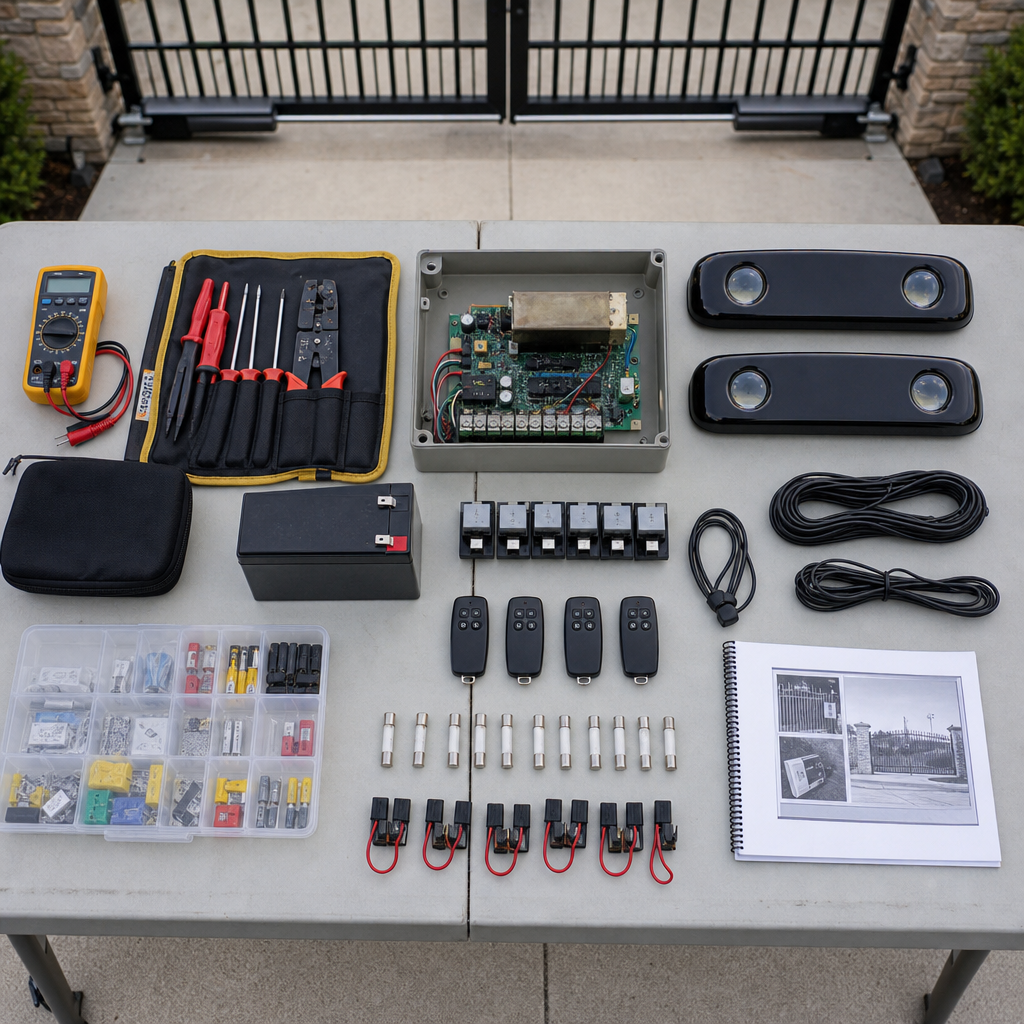
Before inspecting your gate operator, gather basic tools and check the physical structure. Structural shifts or physical wear can introduce mechanical resistance on hinges or tracks, overloading the drive mechanism.
Essential Tools
- Standard hand tools (insulated screwdrivers, wrenches, hex keys)
- Torpedo level (to check post and track alignment)
- Clean microfiber cloth (for cleaning optical lenses)
- Manufacturer-recommended lubricant for mechanical hardware
- Operator manual for model-specific instructions
Quick Diagnostic Triage
- Check Main Power: Look for tripped breakers at the main panel, secondary sub-panels, or reset switches.
- Inspect Safety Devices: Check safety sensors for obstructions or alignment issues according to the operator manual.
- Check for Mechanical Bind: Consult the manual to safely test manual gate movement and feel for physical resistance.
Step 1: Check Power Supply and Electrical Components
Ensure the system is receiving power by checking external supply switches and breakers. Outdoor electrical circuits are exposed to weather, which can trip external protection devices.
Verifying Breakers and Power Switches
Start at the breaker panel feeding the gate. Verify that breakers, inline disconnects, or external reset switches are turned on. If batteries are used for backup power, check that they are properly maintained according to manufacturer recommendations.[3]
Electrical Diagnostics and Repairs
For any internal electrical testing, capacitor diagnostics, or control board repairs, do not attempt live testing or manual capacitor discharge. Always contact a qualified technician to perform electrical diagnostics and repairs safely.
Step 2: Inspect and Maintain Safety Sensors
Safety devices like photo-eyes are designed to detect obstacles in the gate path. If safety sensors detect an obstruction or experience a fault, operators are typically designed to stop or reverse gate movement.[4]
Cleaning and Visual Inspection
Optical sensors can become obstructed by dirt, spider webs, or debris. Gently wipe sensor lenses with a clean, damp microfiber cloth and remove any physical blockages from the sensor path. Refer to the operator manual for sensor indicator lights and specific alignment procedures.[2]
Safety Device Faults
If safety devices fail, show persistent fault indications, or cannot be aligned following the manufacturer’s instructions, stop automatic operation immediately and arrange for a qualified professional inspection. Never bypass safety sensors.
Step 3: Test Remote Transmitters, Keypads, and Access Controls
When a gate fails to respond to a control device, determine whether the issue is isolated to a single transmitter or affects all access controls.
Batteries and Antenna Inspection
Replace remote transmitter batteries first. Inspect external antennas to ensure they are undamaged and positioned according to the manufacturer’s guidelines. Check for obvious sources of radio frequency interference or physical damage to keypad enclosures.
Access Control Inputs
If hardwired push buttons, keypads, or loop systems fail to operate the gate, consult the operator manual. For wiring inspections or loop detector servicing, contact a qualified technician.
Step 4: Examine Hinges, Rollers, and Physical Alignment
Need electric gate troubleshooting?
We’re available now - call for a fast, free estimate.
According to installation specialists at Ironworks Gate Co., mechanical binding is a common cause of gate operator strain. Physical wear, settling, or misaligned hardware can create excessive resistance.
Checking Hinge and Track Alignment
Inspect posts, hinges, and tracks for signs of damage or misalignment:
- Check that gate posts remain plumb and secure.
- Inspect swing gate hinges for binding, corrosion, or lack of lubrication.
- For slide gates, clear dirt, stones, and debris from the track, and check rollers for wear or seized bearings.
Step 5: Safe Use of the Manual Emergency Release
Manual release mechanisms allow the gate to be moved by hand during power outages or servicing. However, release mechanisms differ significantly by model.
Operating the Manual Release
- Always consult and follow the manufacturer’s specific instructions for your model.
- Switch off power where the manual requires it before engaging the release.
- Secure the gate against unintended movement before releasing the drive mechanism, especially on slopes or uneven ground, to prevent the gate from moving freely.
- Engage the release key, lever, or pin as specified in the operator manual.
Step 6: Identifying Operational Sounds and Mechanical Faults
Unusual sounds during operation can indicate mechanical or electrical issues:
Motor Humming Without Movement
A humming motor that fails to move the gate may indicate severe mechanical binding, drive train issues, or an internal component failure. If the gate does not move freely when disengaged, check for physical obstructions. For internal motor or electrical issues, consult a professional technician.
Clicking Sounds
Clicking without motor movement often indicates relay activation without power reaching the motor. Have a qualified technician inspect the electrical system and control board.
Limit Switch and Travel Adjustments
If the gate stops short or overtravels, travel limits may require adjustment. Refer strictly to the manufacturer’s manual for proper calibration procedures.
When to Call a Professional Technician vs. DIY
As noted by Ironworks Gate Co., homeowners can safely perform routine visual inspections, clean optical lenses, clear track debris, replace transmitter batteries, and reset external breakers. Contact a qualified technician for:
- Internal electrical troubleshooting, line-voltage testing, and control board repairs.
- Motor, gearbox, and capacitor diagnostics and replacements.
- Structural repairs, post realignment, and heavy mechanical adjustments.
- Safety device replacement and force-limit compliance testing.
Frequently Asked Questions About Electric Gate Troubleshooting
Why is my electric gate not opening with the remote?
Check the remote transmitter batteries first. If the battery is good, verify that the operator has power and that the antenna is intact. If other access controls work, the remote or receiver may require service or reprogramming according to manufacturer instructions.
Why does my driveway gate start to close and then reverse?
This typically indicates that a safety sensor is obstructed, dirty, or misaligned, or that the gate encountered physical resistance triggering its force-reversal safety feature. Clean and check sensor alignment using the operator manual. If safety devices fail, discontinue automatic operation and call a technician.[5]
What causes an electric gate motor to hum or click without moving?
A hum often points to mechanical binding in the hinges or track, or an internal motor component failure. A clicking sound without movement may indicate an electrical or relay issue. A qualified technician should diagnose and repair internal electrical components.
How do I test and align safety sensors on an electric gate?
Refer to your operator’s manual for specific sensor LED indicators and alignment steps. Clean the lenses with a soft cloth and ensure no objects block the beam path. If sensors remain unresponsive or show persistent faults, stop automatic operation and arrange for professional service.
How should I safely use the manual emergency release?
Release mechanisms differ by model, so always follow the manufacturer’s instructions. Secure the gate against movement, switch power off where the manual requires it, and operate the release mechanism as directed.
When should I call a professional technician instead of DIY gate repair?
Call a qualified technician for internal electrical diagnostics, capacitor or motor repairs, structural realignment, welding repairs, and any unresolved safety device failures.
Need electric gate troubleshooting?
We’re available now - call for a fast, free estimate.
Sources
- Final Rule – Safety Standard for Gates and Enclosures – CPSC – cpsc.gov (2020)
- 40100 – govinfo.gov (2020)
- CHAPTER SIX Automatic Electric Gates – nwfdaz.gov
- Risks to pedestrians from crushing zones on electrically … – hse.gov.uk (2001)
- Guidelines on the Safety of Powered Gates – hsa.ie (2026)
Related reading: Electric Gate Problems – Call Now-10% Off – Same-Day Service – Free Estimate
Related reading: Open Electric Gate Manually – 10% Off & Free Estimate – Same-Day Service
Related reading: Automatic Gate Opener Troubleshooting – Call Now-10% Off – Same-Day Service – Free Estimate
Frequently Asked Questions
What causes an electric gate to bind or drag after seasonal weather changes?
Soil shifting, frost heave, and extreme temperature fluctuations can move support posts out of plumb or misalign slide tracks, creating heavy mechanical friction. If your gate binds even after cleaning debris and lubricating hardware, Ironworks Gate Co. recommends professional post and track realignment to avoid burning out the motor.
How can you tell if an electric gate operator has a bad run capacitor?
A failing capacitor typically causes the motor to hum and vibrate without turning, or it may struggle to start moving until given a manual push. Because gate capacitors store hazardous high-voltage charges even when disconnected, Ironworks Gate Co. advises having a certified technician safely test and replace internal electrical components.
How often should automated gate safety devices and force-reversal limits be tested?
Optical photo-eyes should be inspected and cleaned monthly, while force-reversal mechanisms require testing every six months to confirm the gate automatically reverses upon contact. If safety sensors show persistent fault lights or fail to trigger an immediate reverse, discontinue automatic use and schedule a professional safety calibration.
About the author
 |
Sarah Miller Sarah Miller is a specialized content writer focusing on home and commercial security infrastructure, with a particular emphasis on automated gate systems. With five years of experience writing for property management and home improvement publications, she breaks down complex repair and pricing information into actionable advice. Sarah holds a B.A. in Communications from the University of North Texas. |
Gate not opening, off track, or opener dead?
We’re available now - call for a fast, free estimate.
Call Now - Free Estimate