
Last updated August 25, 2026
Free on-site gate assessment - hinges, posts, and your LiftMaster or Nice gate operator checked before anything is quoted
The assessment is free and the quote is the invoice.
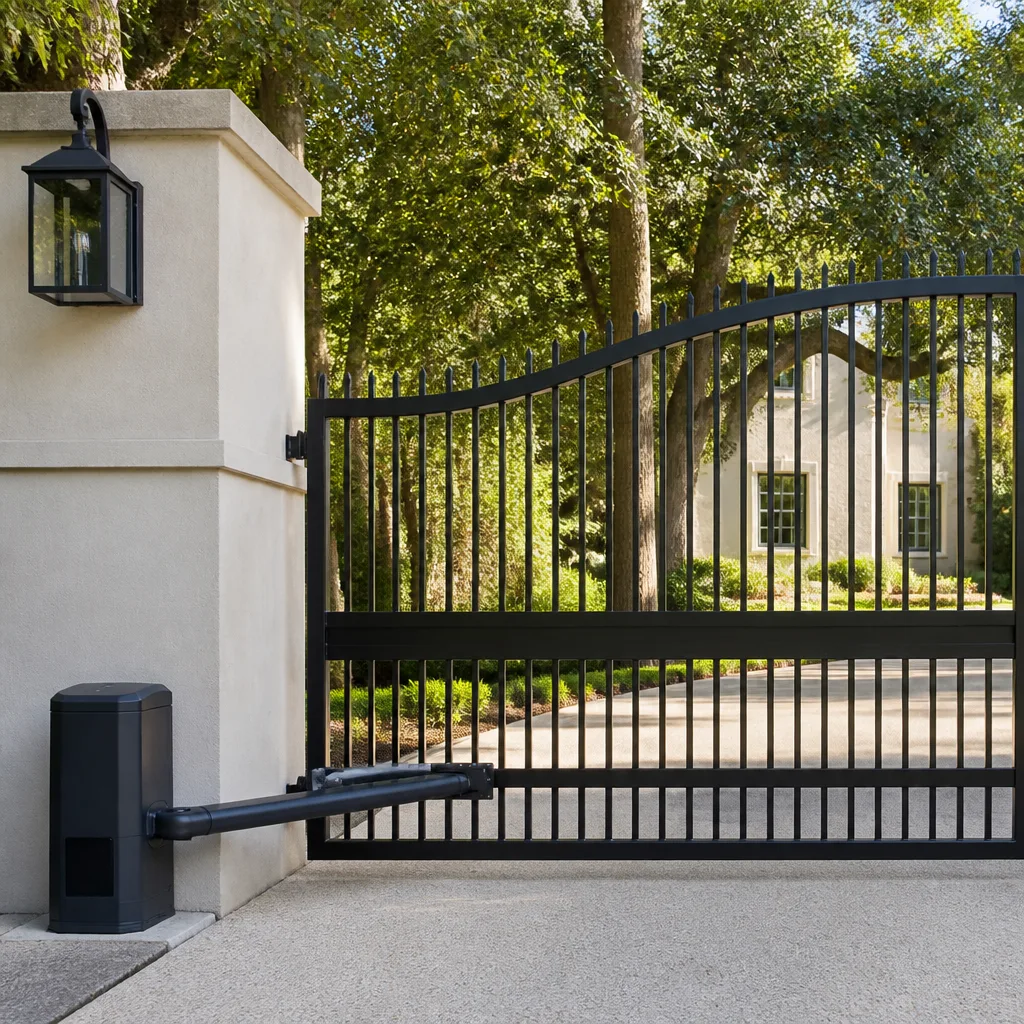
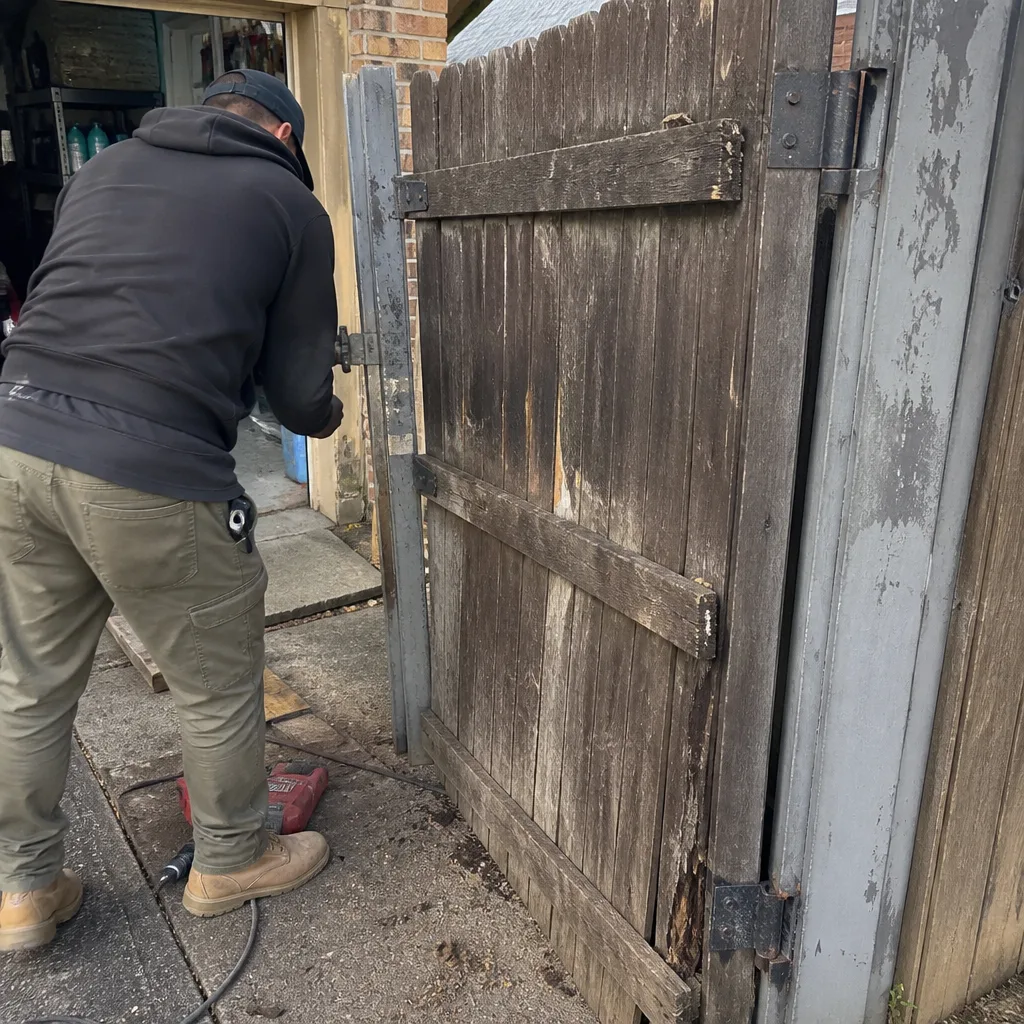 Before
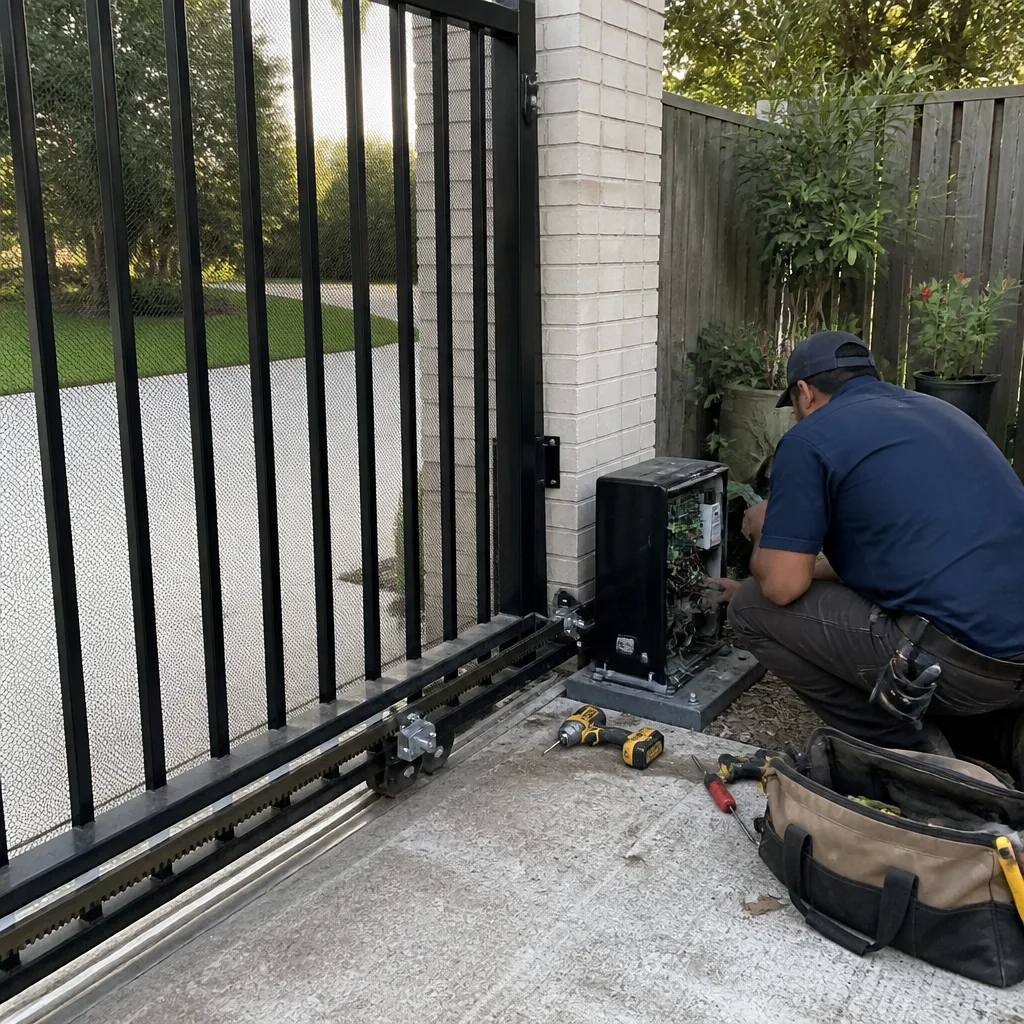 After
After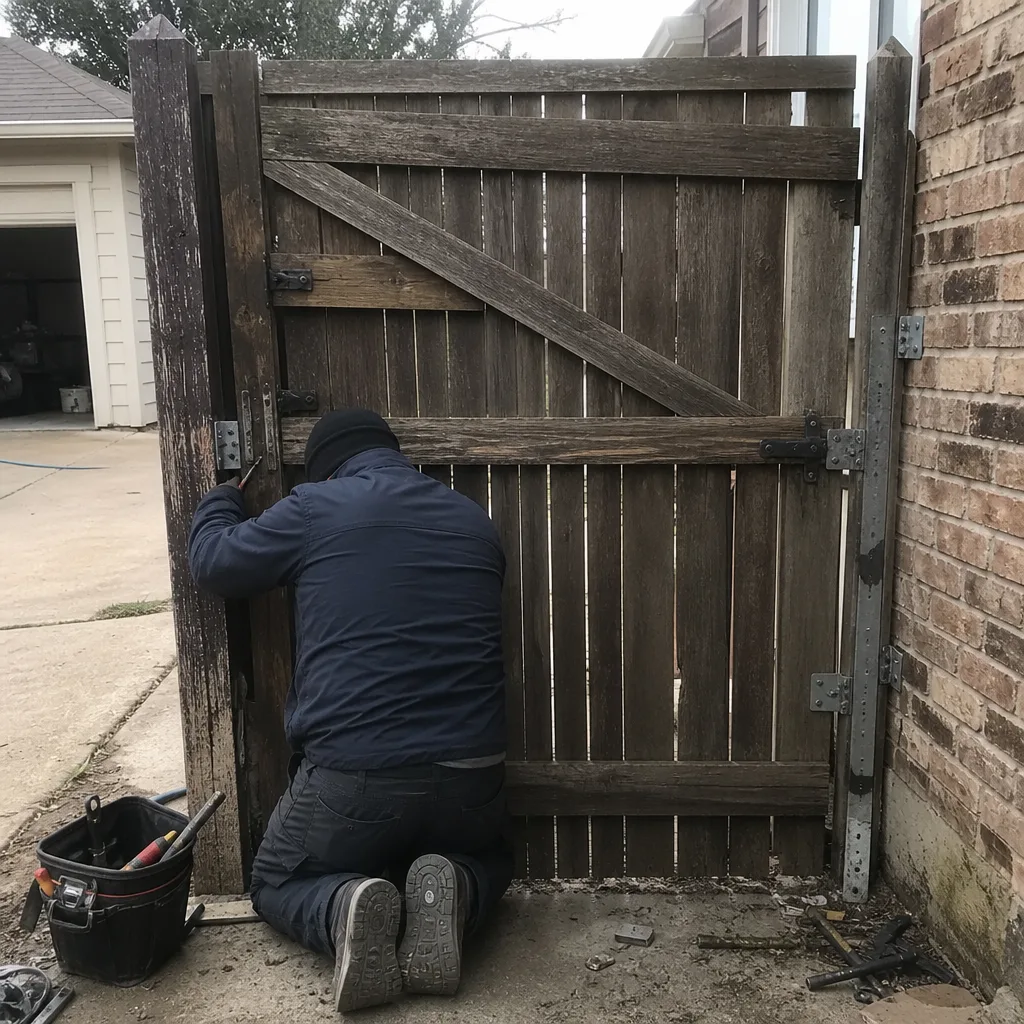 Before
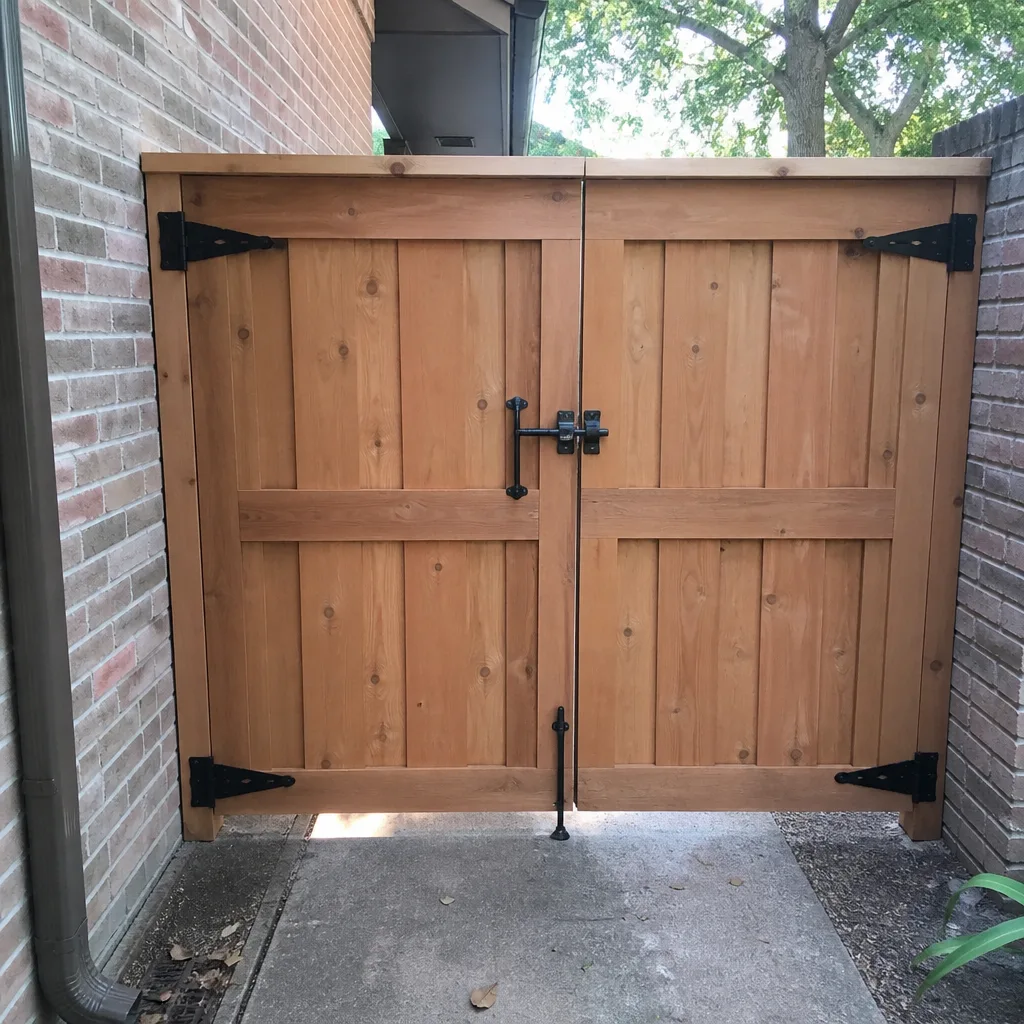 After
After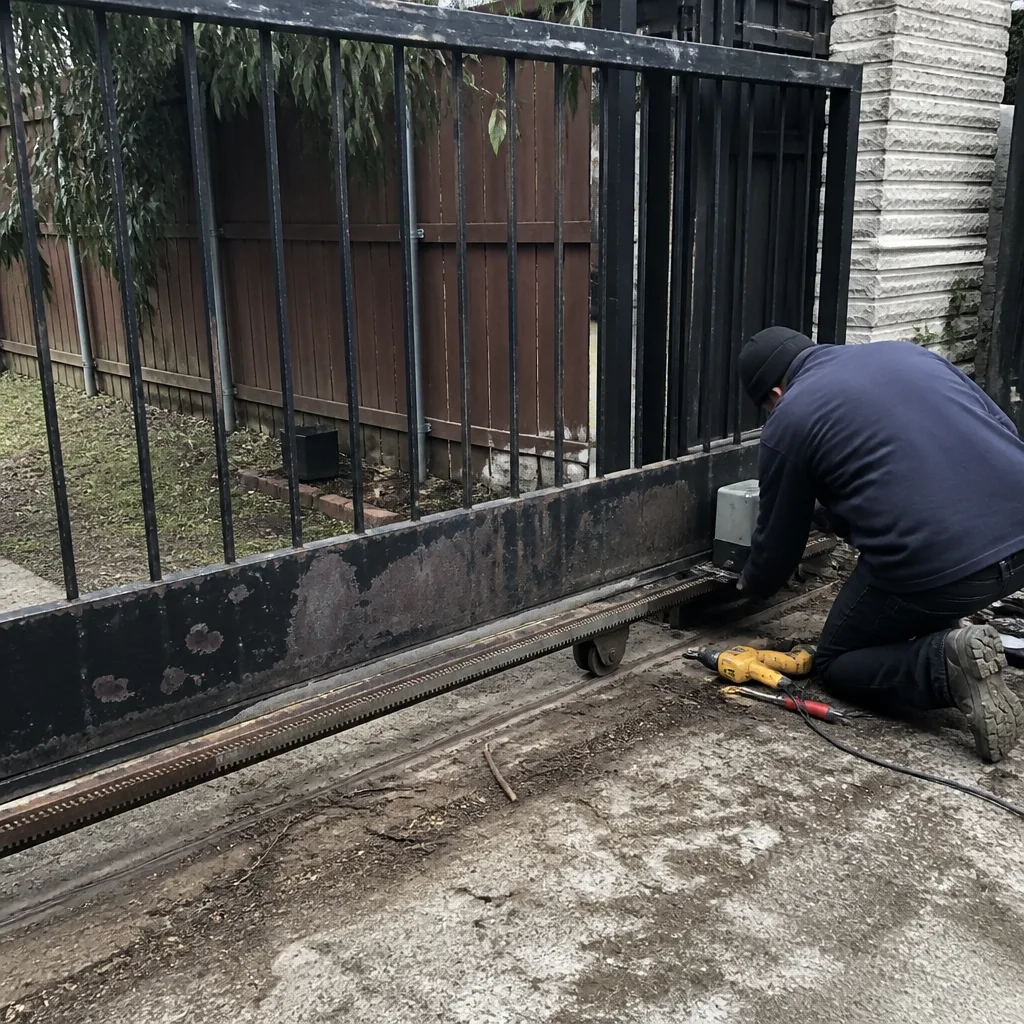 Before
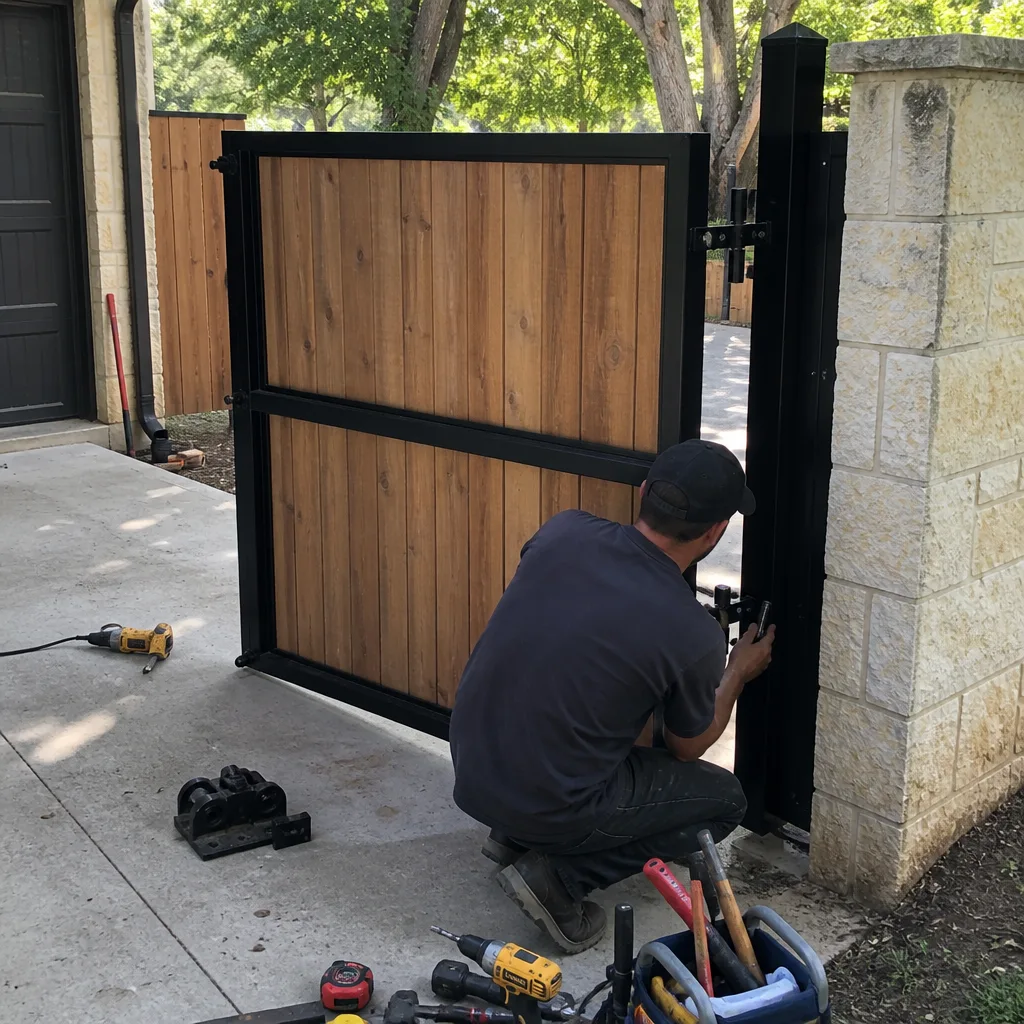 After
AfterDIY vs Professional Gate Repair: The Richardson Homeowner’s Decision Guide
A sliding driveway gate that won’t budge costs more than convenience. In Richardson, where July heat regularly pushes past 100 degrees, a gate stuck in the closed position means a car idling on a hot concrete driveway while the opener motor grinds itself toward an early grave. Most homeowners don’t realize that roughly 7 out of 10 gate failures we respond to involve a problem the homeowner could not have safely diagnosed from a YouTube video, because the visible symptom (gate won’t open) rarely matches the actual fault (sheared coupling inside the gearbox, or a failing capacitor on a control board). This guide walks through what a Richardson homeowner can reasonably fix, what you genuinely should not touch, and how to tell the difference before you spend money on the wrong solution. We’ve taken apart, welded, rewired, and rebuilt more gates across this city than any company should have to, and we’ll show you what that experience has taught us.
Quick Answer
DIY gate repair makes sense for simple maintenance tasks like tightening hardware, cleaning photo-eye sensors, and replacing remote batteries, but most mechanical and electrical failures on Richardson driveway gates call for a professional. Misaligned tracks, welded frames, and automation faults (motors, control boards, limit switches) are not beginner-friendly jobs, and an improper repair usually costs more than calling someone who does this work every day. In many Richardson cases, a homeowner can handle basic upkeep if the gate still moves, but if the gate is bound, sagging, silent, or arcing, call a pro before the damage compounds.
Table of Contents
- What It Actually Costs: DIY vs Pro
- Safety Realities of Gate Repair
- 5 Gate Jobs a Richardson Homeowner Can Do Well
- Jobs You Should Hand to a Professional
- How Richardson’s Climate and Soil Attack Gates
- Why Gate Motors and Electrical Work Demand Training
- The Hidden Cost of Getting It Wrong
- Common Mistakes to Avoid
- When to Call a Professional
- Frequently Asked Questions
- The Bottom Line
What It Actually Costs: DIY vs Pro
We’re going to give you the honest math. A DIY gate repair costs whatever the parts cost, plus your time, plus the cost of whatever breaks because something was installed wrong. A professional repair in Richardson typically falls into predictable bands depending on what failed. Here’s what we see on a regular basis across Richardson zip codes:
- Hinge replacement (sliding or swinging gate): $150-$400 per hinge, depending on gate weight and steel grade. DIY parts might run $40-$120 per hinge, but a hinge bolted through a rusted post will fail again in months.
- Photo-eye sensor replacement: $120-$250 installed. DIY cost is $30-$80 for the part, assuming the wiring is not the problem.
- Opener motor/gearbox replacement: $900-$2,400 installed, brand-dependent. This is a job with almost no good DIY path, because the replacement must match the gate’s duty cycle, leaf weight, and control setup.
- Welded steel frame repair (cracked gate member): $350-$900, depending on crack length and access. A homeowner with a $200 flux-core welder can glue metal, but gluing a load-bearing gate joint is how gates end up on the ground.
- Control board or limit switch repair: $300-$800 installed. These are high-skill diagnostics. If you misdiagnose the board and replace a working part, nobody refunds the part.
- Full track replacement (sliding gate): $800-$2,500 based on run length and backfill condition. This is a multi-person job with concrete and grading implications.
Every professional quote we give in Richardson is firm before work starts. The price we quote is the price on the invoice. No allowances, no open-ended time-and-materials. That’s a significant difference from the DIY path, where a $60 “simple” fix can spiral into a $900 replacement because the first repair made the original problem harder to see.
Safety Realities of Gate Repair
Let’s be plain: a driveway gate is one of the heaviest moving objects on your property. A typical 14-foot steel sliding gate weighs between 600 and 1,800 pounds. A wrought-iron swing gate can go well past that. When a gate falls, it does not stop for a hand, a dog, or a child. We have responded to gates that collapsed onto vehicles in driveways when a homeowner attempted to remove a single welded hinge pin without supporting the leaf. The hospital bill was more than the gate repair would have been.
Richardson building codes require automatic gate systems to have functional safety entrapment protection. That’s not red tape. It’s the response to real injuries and deaths from gates that reversed too late or never reversed at all. A gate that closes on a car fender is an inconvenience. A gate that closes on a person is a life-changing event. When anyone in our shop works on a gate with an automation system, the first step is to disconnect and lock out the power, remove mechanical tension where applicable, and prop the gate. We recommend any homeowner attempting even minor hinge or roller work do the same, but we also recommend being honest about whether you can safely support the weight involved. If the answer is “maybe,” call someone who does it daily.
5 Gate Jobs a Richardson Homeowner Can Do Well
Not everything needs a service truck. We tell our Richardson neighbors this all the time: if you’re handy, there are maintenance tasks you can and should do to extend the life of a gate. Here are five we routinely recommend homeowners handle themselves:
- Remote control battery replacement. If your remote works only from five feet away, it’s usually the battery (or a dying capacitor in the receiver, but battery first). Visor remotes take CR2032 or A23 batteries. This is a two-minute job that costs under $10.
- Photo-eye cleaning and realignment. Richardson’s wind, dust, and construction debris regularly coat photo-eye lenses. A soft cloth and a gentle realignment so the two eyes face each other fixes a surprising number of “gate won’t close” complaints. Don’t scrub the lens with anything abrasive.
- Track and roller debris clearing. Sliding gates accumulate dirt, grass clippings, leaves, and moisture in the bottom track. Clearing the track by hand and hosing out debris (when you’re certain the electrical components are out of the water path) keeps a smooth-running gate running smoothly. This is maintenance, not repair.
- Hardware visual inspections. Once a season, walk the gate and check for loose carriage bolts, cracked welds, sagging hinges, and worn rollers. You’re looking, not fixing. If you find something, make a note and call. Early catch saves hundreds.
- Lubrication of the right parts. A gate owner can lubricate hinges, rollers, and chains (where applicable) with a quality penetrating lubricant. But here’s the part most people miss: you lubricate the moving joints, not the track. A greasy sliding track collects dirt and wears rollers faster.
These five tasks keep a healthy gate healthy. They will not fix a failing motor, a cracked weld, or a control board that’s losing its mind. The line is: if the gate is heavy and the problem is weight, structure, or electricity, stop. Maintenance is not structural repair.
Jobs You Should Hand to a Professional
Here’s the short list of what a Richardson homeowner should not do alone. These are not skill-shaming judgments. They’re based on what we’ve seen go wrong:
- Broken torsion or extension springs on a cantilever or swing gate. Springs store massive amounts of energy. A spring that lets go under tension becomes a projectile. The injury risks are real and permanent.
- Welded frame repairs. A cracked gate is one that has been moving under stress for months. A cosmetic weld over a stress crack does not fix the engineering underneath. The right repair involves grinding out the crack, preheating, welding with proper filler, and often adding a reinforcing plate. This is fabricator territory.
- Opener motor replacement. The motor is married to the gate’s weight, length, daily cycles, and environment. Spec the wrong motor and the new one burns out within a season. Our technicians carry motors and gearboxes matched to gate load, not just “whatever is on the truck.”
- Control board diagnostics. A control board can fail in a dozen ways that all look the same to a homeowner: the gate does not respond. The difference between a dead board, a failing capacitor, a miswired keypad, and a tripped breaker is the difference between a $150 fix and a $1,200 waste.
- Track and foundation work. Richardson’s clay soil expands and contracts with significant seasonal movement. A track that has shifted means the concrete underneath has moved, and the repair is a leveling and re-anchoring project, not a bolt-tightening project.
- Any job involving a live power source. Gate openers run on 110V or 220V, with 12V or 24V DC components downstream. If you are not comfortable testing for live voltage, wait for someone who is. A gate opener is not the place to learn electrical troubleshooting by trial and error.
How Richardson’s Climate and Soil Attack Gates
Richardson has its own set of gate problems, and if you’ve lived here since the 90s, you’ve lived through them all. The soil is the big one. Richardson sits on the Blackland Prairie, a band of dark, clay-heavy soil that expands when wet and contracts when dry. You’ve seen what that does to sidewalks and home foundations. It does the same thing to gate posts, concrete track beds, and the soil under a swing gate’s low-hanging bottom rail. Foundation movement shifts gate hardware. A gate that swung freely for fifteen years will suddenly drag at the latch side when the ground swells after a wet spring.
Then there’s the heat. Summer days in the upper 90s and beyond bake motors, control boards, and plastic gear components in metal enclosures. Heat is a silent gate killer. It degrades wire insulation faster than almost anything else we see. It ages capacitors. It makes plastic gears brittle. If your Richardson gate system is ten years old or older and has been housed in an unvented steel box the whole time, the electronics are living on borrowed time. We regularly see openers in this city that look fine on the outside and are milliseconds from component failure on the inside.
Moisture also cycles through Richardson with a rhythm many homeowners underestimate. Spring thunderstorms, the May into June wet stretch, then long dry spells into August. Gates that sit tight to the ground collect splashback, and gates with low-mounted control boxes collect condensation. Water intrusion is the root cause of many “sudden” opener failures that weren’t sudden at all.
The takeaway for the do-it-yourselfer: if you’re diagnosing a gate problem in Richardson, consider the ground before you consider the gear. Check for soil movement around posts and tracks, look for moisture inside control enclosures, and inspect wired connections for heat discoloration. None of this costs a dime, and it often tells you more than the gate itself does.
Why Gate Motors and Electrical Work Demand Training
Some jobs are mechanical. Some are electrical. Some are both. A modern automatic gate is both, and that’s where DIY repairs go sideways. We are trained and certified to service nine major gate-automation brands on the market, including LiftMaster, FAAC, BFT, and Linear. Each brand has its own control logic, its own programming sequence, its own failure pattern, and its own way of lying to a technician who’s never touched one before. What works on a LiftMaster control board will not work on a FAAC. What a Linear motor expects from its limit switches is different from what a BFT system expects.
A homeowner with a multimeter and a willingness to learn can test basic continuity. That much is fair. But modern gate control boards involve logic you cannot test with a continuity beep. You need to understand how the board interprets sensor inputs, how it times out, how it stores fault codes, and how to reset programming without bricking the board. We’ve met more than a few homeowners who replaced a perfectly good control board because the real fault was a corroded wire nut six inches away from the board. That’s a $450 mistake on a repair that would have been $150 if diagnosed correctly.
Electrical gate work is also not isolated. The gate opener ties into your home’s electrical system. A bad capacitor can blow a transformer. A miswired loop detector can leave an underground sensor energized. A ground fault can energize the gate frame itself. When we work on a Richardson property, we check the whole circuit, not just the component. That’s the difference between making the gate open today and making the gate safe for ten years.
The Hidden Cost of Getting It Wrong
We want Richardson homeowners to understand the real cost structure here. The cheap part is always the part itself. The expensive part is the secondary damage. Here’s how that plays out in practice:
- A misdiagnosed sensor problem becomes a motor replacement. A gate that keeps hitting an obstruction and reversing is often a sensor issue. But if the gate continues to run against a misaligned sensor, the motor overheats. Wait too long and the cheap fix becomes a four-figure motor replacement.
- A loose hinge becomes a bent leaf. A swinging gate with a sagging top hinge looks fine until the leaf drops far enough to catch on the pavement. Once the bottom rail catches, the gate twists. Now the hinge replacement is also a frame straightening.
- A skipped track repair becomes a foundation repair. When a sliding gate runs on a shifting track, the wheels wear unevenly and then the gate binds. Force a bound gate with a strong opener and you transfer all that stress into the concrete and the frame. The $800 track repair becomes a $3,000 structural repair.
- A ignored rust spot becomes a weld failure. North Texas gets enough humidity and rain for steel to move. A small rust blister near a weld is a structural time bomb, especially on older Richardson gates from the 1980s and 90s construction boom. Grind, treat, and weld it now, or replace the whole bottom rail later.
We’ve built our whole business around a simple idea: a job done right the first time is always cheaper than a job done wrong twice. That’s why we standardize on written quotes, one-visit fixes, and the 90-Day Done Right Promise: if it’s not right, we come back and make it right, no paperwork and no arguing. That’s the Keystone Standard we hold every job to, whether it’s a $90 tune-up or a full gate replacement. You won’t get a second invoice because we misjudged it the first time.
Common Mistakes to Avoid
- Lubricating the track instead of the rollers. Grease on a sliding gate track is a magnet for Richardson dust and dirt. The track should be clean and dry. Lubricate the roller bearings and hinge pins only.
- Using the wrong hinge pin material. A homeowner sees a rusted pin and replaces it with a hardware store bolt. Within a season, the bolt galls, the hinge wears, and the gate sags. Original pins are specific diameters and grades. Match them.
- Welding without clearing the area. A weld repair on a gate near dry grass or a wooden fence line in an August dry spell can start a fire in minutes. Richardson has seen grass fires from less. If you’re welding, cleared ground and a fire extinguisher are not optional.
- Replacing a remote before testing the receiver. A dead remote is the most common gate complaint. But if the receiver board has a failing antenna connection, a new remote will work only from arm’s length. Test with a known working remote before buying new.
- Ignoring the gate’s weight when adjusting opener settings. If a homeowner cranks up the force setting to make a binding gate move, the gate will move. It will also strain the motor, burn out the gearbox, and create an entrapment hazard, because the gate now pushes with more force than the safety system can respond to.
- Doing electrical work with the breaker on. This sounds obvious. It is ignored constantly. A gate opener’s capacitor can hold charge after the breaker is off. Discharge it, test it, then work on it.
- Ignoring a gate that’s getting slower. A gate that gradually slows down over weeks is a gate with increasing friction somewhere. That slowdown is a diagnostic clue. Wait until it stops and you’ve lost the easiest and cheapest window to fix it.
When to Call a Professional
Call a professional when the gate is bound and won’t move, when you see cracked welds or rust through the steel, when the motor hums but the gate doesn’t move, when the gate reverses for no reason, when the gate moves too slowly, or when you’ve already tried a DIY fix and the problem returned. Those are not ambiguous signs. They’re engineering signals that something structural or electrical has passed the point of homeowner-level intervention. Richardson is full of gates from the 80s and 90s that are reaching the end of their original hardware life, and the responsible move is to have them inspected before they fail catastrophically. Ironworks Gate Co. offers free estimates in Richardson. Call (903) 627-2906 and we’ll look at the gate, give you a written price, and let you decide. No pressure. No games.
Frequently Asked Questions
Gate motor replacement in Richardson typically runs $900 to $2,400 installed, depending on brand, gate weight, and whether the existing control board and arms can be reused. LiftMaster, FAAC, BFT, and Linear motors all land in this range. Call (903) 627-2906 for a written quote on your specific gate. Estimates are free and the price is fixed before work begins.
A homeowner can sometimes temporarily adjust a sagging gate by tightening hinge bolts and supporting the gate while repositioning hinges, but a permanently sagging gate usually has a worn hinge, a bent post, or a broken weld underneath. Those are structural repairs. If the gate needs to be lifted, propped, and welded back into alignment, that’s a job for a gate professional.
A well-built steel or iron driveway gate in Richardson should last 20 to 40 years with proper maintenance, but the automation system (motor, board, sensors) typically lasts 8 to 15 years. Gates built in Richardson’s 1980s and 1990s housing boom are often still solid structurally and simply need new automation and hardware. The steel usually outlives the electronics by decades.
A gate that opens on its own is usually picking up a spurious radio signal, or the control board is misreading a loop detector or exit sensor. The most common culprit on older systems is a failing receiver with degraded signal filtering. This is an electrical diagnostic issue. A professional can isolate the source and either reprogram or replace the receiving component.
It is generally not safe or effective to weld a cracked gate yourself unless you have structural welding experience. A gate weld carries the full dynamic load of a moving gate, and an improper weld can fail without warning. A professional gate welder will grind the crack, preheat, weld to the proper depth, and often reinforce the member. If you see a crack in your gate’s steel, call a professional before it grows.
Many Richardson gate repair companies charge a trip fee or diagnostic fee, but Ironworks Gate Co. provides free estimates on gate repairs and installations, plus a free second opinion on any written estimate you’ve received from another company. Call (903) 627-2906 and we’ll come out, assess the gate, and give you a written price. No obligation, no fee.
The Bottom Line
A Richardson homeowner can maintain a gate, but only a professional can save it. The skills that keep a gate running for decades are not secret. They’re just specific: structural welding, brand-specific automation programming, load calculation, and diagnostic experience built over thousands of gates. We’ve been doing this work for over 42 years. We’ve seen every frame design, every motor failure, every track alignment mistake a homeowner can make. If it’s loose, lubricate it. If it’s bound, bent, buzzing, or broken, call someone who can make it right the first time. It’s the difference between a gate that holds up for another decade and one that holds up your whole day. Call Ironworks Gate Co. at (903) 627-2906 for a free Richardson estimate. A live person answers. That part is easy too.
Written by Victor Salinas, Owner at Ironworks Gate Co., serving Richardson since 2013.