
Last updated August 25, 2026
Free on-site gate assessment - hinges, posts, and your LiftMaster or Nice gate operator checked before anything is quoted
The assessment is free and the quote is the invoice.
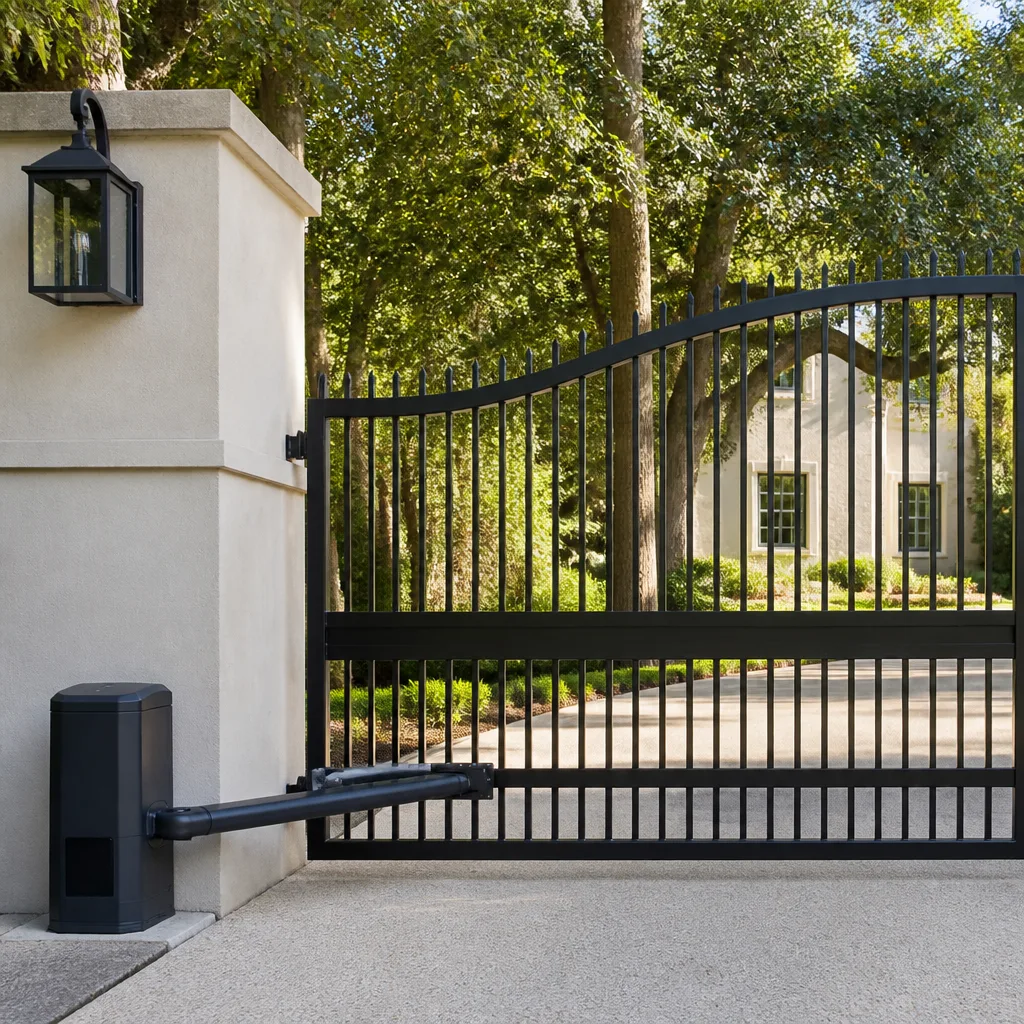
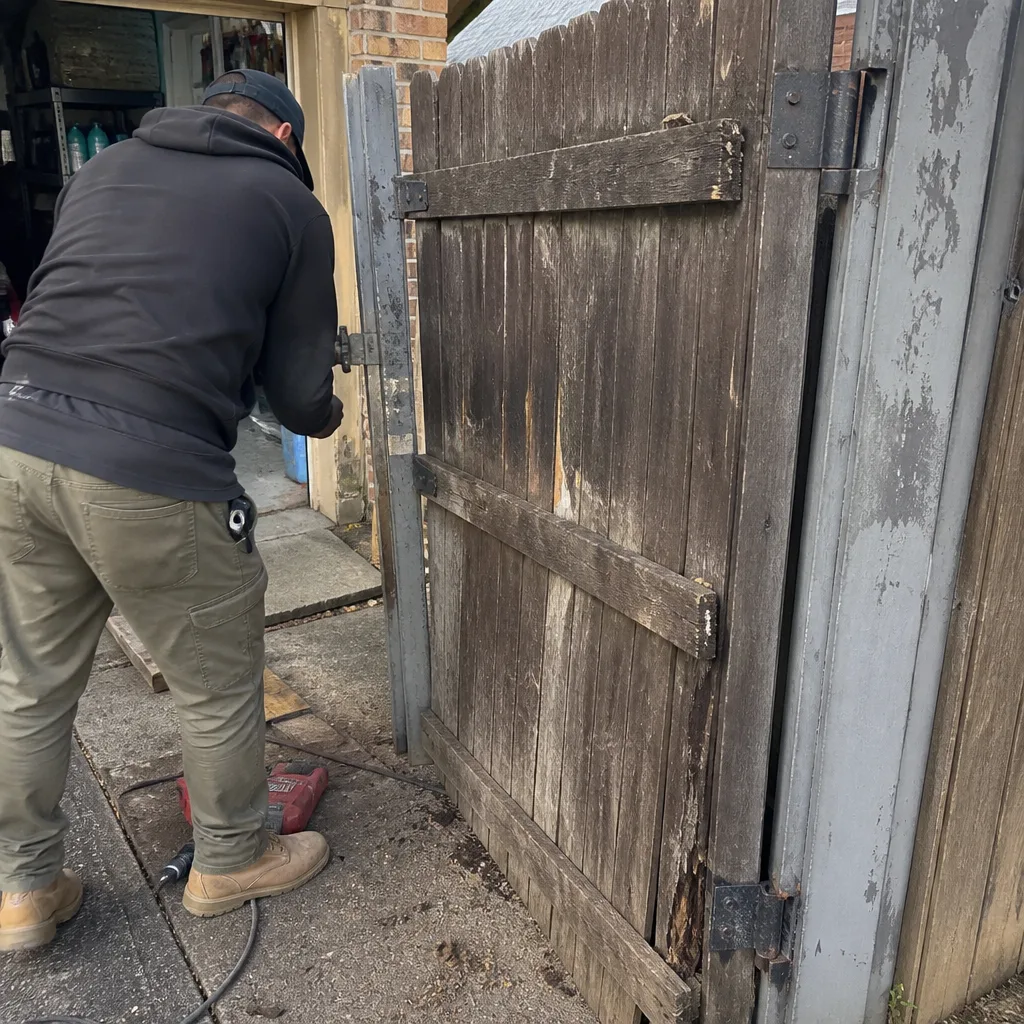 Before
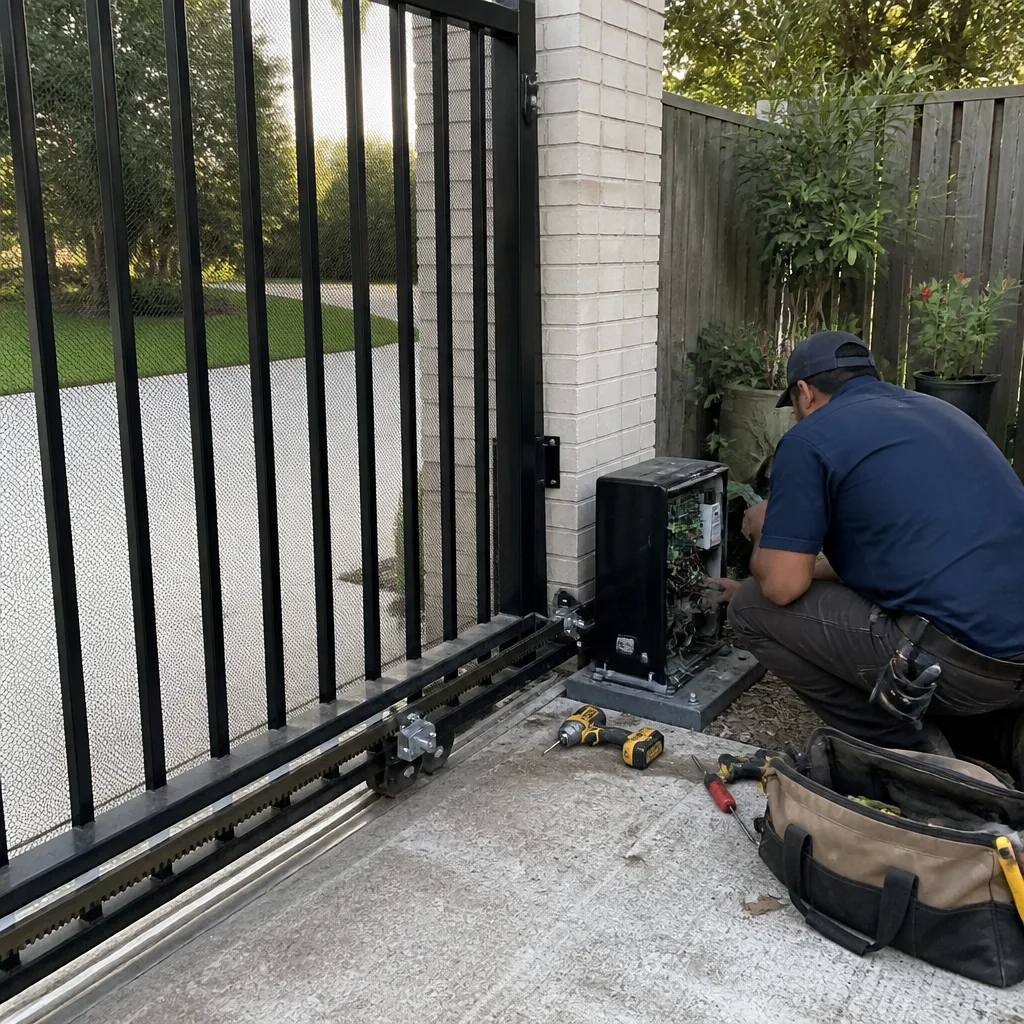 After
After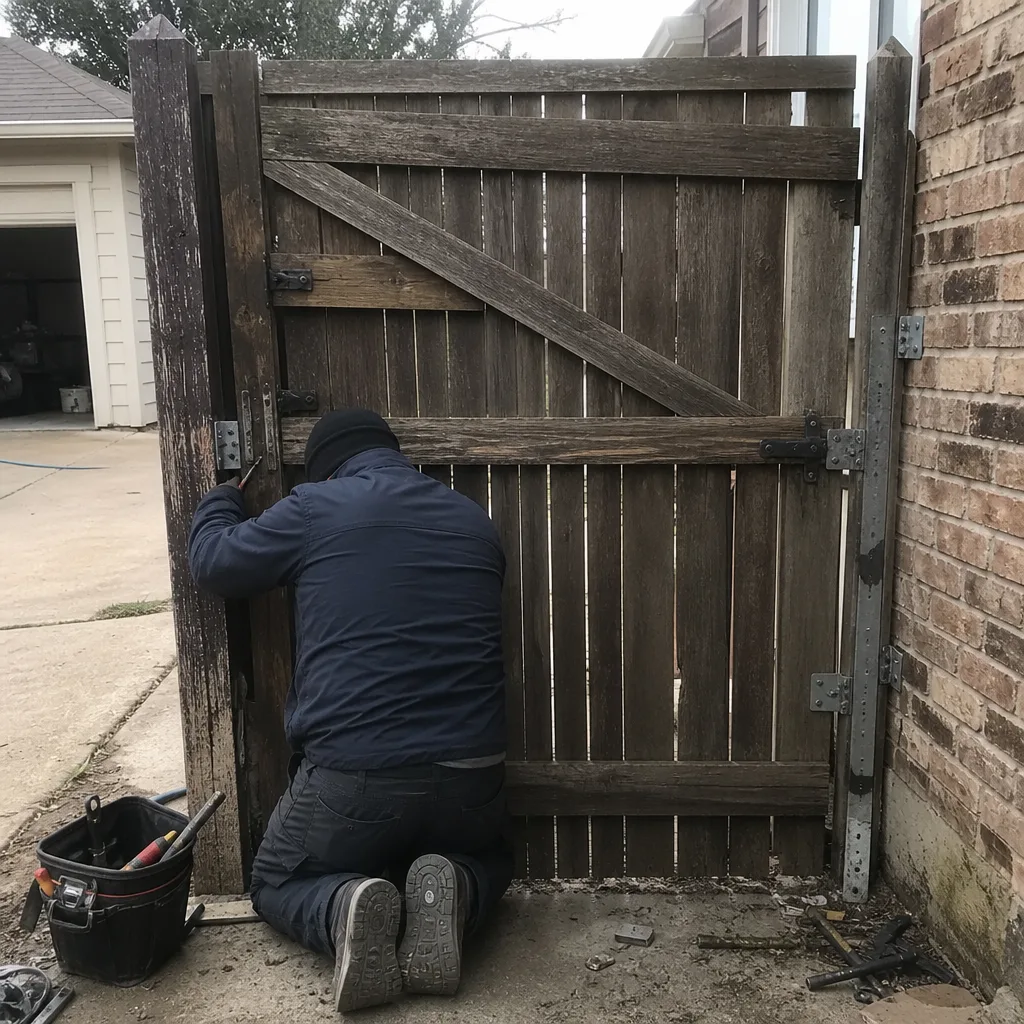 Before
 After
After Before
 After
AfterGate Repair Permits, Codes & Inspections in TX: What You Need to Know
Here is something most Richardson homeowners don’t expect when their driveway gate starts sagging: Texas does not have a single statewide gate repair permit. The state defers almost everything to city and county authorities, and even then, a straight repair job rarely triggers a permit at all. What does trigger one, and what gets a gate flagged during a home inspection, depends on factors most people never think about until a code officer is standing in the driveway. This guide walks through exactly what Richardson and other Texas cities require, when a permit applies, which codes govern gate work, and how inspections actually play out, so you can move forward without guessing.
Quick Answer
Most gate repairs in Texas, including spring, hinge, wheel, and opener replacements on an existing gate, do not require a building permit. A permit is generally required only when you install a new gate or substantially alter the structure, and the specific trigger points are setbacks, easements, height limits, and electrical work for automation, all of which vary by city. Richardson enforces its own local amendments to the International Residential Code, so the safest first step is a quick call to the city’s building department or a gate contractor who already knows the local requirements.
Table of Contents
- Do You Need a Permit for Gate Repair in Texas?
- When a Permit Is Required: New Gates, Automation, and Structural Change
- The Codes That Actually Govern Texas Gates
- Richardson-Specific Rules and Local Amendments
- Electrical and Automation Requirements for Gate Openers
- How Gate Inspections Work in Richardson and Collin/Dallas Counties
- HOA Rules, Easements, and Right-of-Way: What Cities Don’t Tell You
- Permit Costs, Timelines, and What You’ll Actually Pay
Do You Need a Permit for Gate Repair in Texas?
For the vast majority of repairs, the answer is no. Texas building codes, adopted at the local level, treat repair and replacement differently than new construction. Replacing a bent hinge, welding a cracked frame, swapping out a failed gate opener, or installing a new wheel on a sliding gate, none of these require a building permit in Richardson or in most Texas cities. The work is considered maintenance on an existing structure, and the code does not ask cities to regulate maintenance.
That said, there are three situations where a repair crosses into permit territory, and they catch people off guard. First, if the repair involves moving the gate or changing its footprint, that is no longer a repair. Second, if you are adding electrical service that did not exist before, such as running a new circuit from the house to a gate opener that previously ran on solar. Third, if a prior installation was never permitted and the city discovers it during an unrelated inspection, you may be required to bring the entire gate into compliance retroactively. In our experience across Richardson neighborhoods like Canyon Creek, Reservation, and Breckinridge, that third scenario is more common than the first two combined. Older homes built in the 1970s and 1980s often have gates that were installed before the current code cycle existed, and nobody thought twice about it until a home sale triggered a closer look.
When a Permit Is Required: New Gates, Automation, and Structural Change
If you are installing a brand-new driveway gate, assume a permit is required unless you confirm otherwise with your city. Richardson requires a building permit for any new fence or gate over a certain height, and the threshold that matters is usually 7 feet. A new gate under that height may still need a permit if it sits within a front yard setback, within a utility easement, or within a sight triangle at a driveway approach. Here is the practical breakdown:
- New gate, same footprint, under 7 feet, backyard only: No permit in most Richardson cases. Still worth a call to confirm.
- New gate, front yard or side yard visible from the street: Permit likely required. Setback and sight-line review apply.
- New gate over 7 feet tall or with masonry columns: Permit required. Structural review applies, and masonry columns may need engineered footings.
- Adding an electric opener where none existed: Electrical permit required. The circuit must be GFCI-protected and run to code.
- Replacing an existing opener with a similar unit: No permit, provided no new wiring is pulled. This is the most common gate job we do in Richardson, and it is straightforward.
- Widening the driveway opening or moving gate posts: Permit required. This changes the site plan and may trigger zoning review.
One point worth stating plainly: none of these are optional in the sense that you can skip them and hope for the best. Richardson code enforcement does inspect work that requires a permit, and if an unpermitted gate is discovered during a home sale, the title company will flag it. That can delay closing by weeks. The lesson from 42 years in this trade is simple: ask the city first, and if the answer is unclear, ask a gate contractor who works in Richardson every week. They know what the inspectors look for because they have stood next to them on hundreds of jobs.
The Codes That Actually Govern Texas Gates
Texas does not write its own gate code. What applies in Richardson is the International Residential Code (IRC) and International Building Code (IBC), as adopted by the State of Texas and amended locally by the City of Richardson. For gates, the relevant sections live in a few places:
- Chapter 3, IRC (Building Planning): Governs height limits, setback requirements, and structural design. A driveway gate is treated as an accessory structure in most cases.
- Chapter 18, IRC (Electrical): Governs wiring for gate openers, keypads, and intercoms. This is the chapter most gate automation work falls under.
- ASTM F2200: The national safety standard for automated vehicular gates. Texas adopted this standard by reference, and it carries real weight during inspections. It requires safety entrapment protection devices, specific warning signage, and controlled gate speed and force.
- UL 325: The electrical safety standard for gate operators. Any opener installed in Richardson should be UL 325 listed, and the install must follow the manufacturer’s instructions, which now carry code weight.
- NEC Article 300 and 430 (as adopted locally): Governs how the branch circuit, conduit, and motor disconnects are installed for gate operators.
The code reference that matters most to a homeowner is ASTM F2200. That single standard is why modern automated gates have photo eyes, reverse loops, and warning signs. If a gate was installed before that standard was broadly enforced, it may not meet current requirements, and bringing it up to code can be a bigger job than the original repair. In Richardson, we regularly see gates from the 1990s and early 2000s that operate fine mechanically but lack the entrapment sensors that any new inspection would require. The gate motor brands we service most often for these retrofits are LiftMaster and FAAC, both of which make retrofit entrapment kits that satisfy the standard without replacing the entire gate.
Richardson-Specific Rules and Local Amendments
Richardson sits in two counties, Dallas County on the west side and Collin County on the east, but the building code is enforced by the City of Richardson itself, not the counties. That is good news: you deal with one building department, one set of amendments, and one inspection schedule. Richardson has adopted the IRC with local amendments, and the ones that affect gates are worth knowing:
- Height limit: Gates in front yards of residential districts in Richardson are generally limited to 4 feet if they are within the front yard setback, and up to 8 feet in rear yards. A 6-foot driveway gate in the front yard that feels standard in other cities may not fly in Richardson without a variance.
- Sight triangles: Richardson enforces sight triangle requirements at driveway approaches. A gate that blocks a driver’s view of the street or sidewalk can be ordered removed, even if it was permitted at the time of installation. This is a common issue on corner lots in neighborhoods like Arapaho Heights.
- Setbacks: Gates and their posts must sit entirely on your property. A gate that swings out over the sidewalk or into the public right-of-way is a code violation. This catches nearly every new slide gate installation on a small front yard.
- Electrical: Richardson requires a permit for any new electrical circuit, including a dedicated circuit run for a gate opener. A licensed electrician must do the work, or the gate contractor must hold the appropriate license and pull the permit.
- Zoning overlays: Some Richardson neighborhoods, particularly those in the historic districts or with conservation overlays, have additional design review for visible gates. The city planning department maintains a list of these overlays, and it is worth checking before you order a custom iron gate.
In practice, what we tell Richardson homeowners is this: if you live in a typical suburban lot in Reservation, Canyon Creek, or Yale Park and you are repairing or replacing what is already there, you likely need no permit. If you are changing the footprint, height, or adding power, call the City of Richardson Building Inspection Division first. The staff answers the phone, and a ten-minute conversation can save you a six-week delay later.
Electrical and Automation Requirements for Gate Openers
Automated gates are where codes genuinely bite. A mechanical gate that swings on hinges and closes with a latch is governed by basic structural rules. An automated gate with an opener, photo eyes, and a keypad is governed by electrical code, the UL 325 standard, and ASTM F2200, all at once. That is three overlapping sets of rules, and they are all written with one goal: nobody gets hurt.
Here is what a compliant automated gate installation in Richardson requires, step by step:
- Dedicated circuit: The opener must run on a dedicated branch circuit with GFCI protection. The circuit originates at a panel in the house, not from an extension cord or a shared garage outlet. Running this circuit is electrical work that requires a permit.
- Disconnect means: There must be a readily accessible disconnect within sight of the gate operator. This lets a technician or a first responder kill power without walking back to the house. This is a code item inspectors check specifically.
- Entrapment protection: Photo eyes or contact edges must monitor the gate’s path and reverse the gate if anything crosses it. ASTM F2200 requires two independent means of entrapment protection for most gate types. A single photo eye is not enough on a slide gate.
- Warning signage: Two warning signs are required on each side of an automated gate, mounted at a specific height and with specific wording. This is the easiest code item to miss and the one inspectors point to most often.
- Force and speed limits: The operator must be set so that the gate stops and reverses if it meets resistance. This is a UL 325 requirement and is tested during a proper installation. The gate must also travel at a controlled speed, not slam open or closed.
- Manual release: Every automated gate needs a manual release mechanism so the gate can be opened by hand during a power outage. This is both a code requirement and a practical necessity in Richardson, where ice storms have knocked out power to whole neighborhoods for days.
We are trained and equipped on nine gate-automation brands, including LiftMaster, FAAC, BFT, and Linear, and the single most common call we get after an inspection failure is a missing photo eye or a missing warning sign. Both are cheap fixes. Both will fail an inspection. Neither is worth the delay.
How Gate Inspections Work in Richardson and Collin/Dallas Counties
If your gate job does require a permit, an inspection will be scheduled as part of the permit process. The City of Richardson uses a standard sequence for accessory structures like gates:
- Site inspection, before work begins: An inspector verifies the gate location, setbacks, easements, and sight triangle. This happens before concrete is poured for new posts.
- Rough electrical, if applicable: For automated gates, the inspector checks the circuit, conduit, and disconnect before the gate is fully assembled. Trench depth and conduit material are common points of failure here.
- Final inspection: The inspector confirms the gate meets height and setback requirements, functions safely, and includes all required signage and entrapment protection. For an automated gate, the operator is cycled under the inspector’s watch.
Richardson inspectors are thorough but practical. They want the gate to meet code, and they are generally willing to walk a contractor through a deficiency if it is minor. What they will not do is pass a gate that lacks entrapment protection or a proper electrical disconnect. Those are life-safety items, and the inspector’s job depends on getting them right. If you are working with a gate contractor who has done permitted work in Richardson, the inspection is usually a formality because the contractor already knows what will be checked. If this is the contractor’s first Richardson inspection, you may be paying for the learning curve.
HOA Rules, Easements, and Right-of-Way: What Cities Don’t Tell You
A city permit is not the only gate you have to pass. Most Richardson neighborhoods built after 1980 have a homeowners association with architectural control, and many homes built between 1950 and 1980 are in established subdivisions with deed restrictions that still carry legal weight. The city will not check your HOA covenants, and the HOA will not check the city code. You are responsible for both.
Here is what to verify before you start a gate project in Richardson:
- HOA architectural review: Many Richardson HOAs require written approval before any gate or fence visible from the street is installed or significantly altered. The approval process can take 30 days, which should be factored into your timeline. Neighborhoods like Canyon Creek and Town North have active architectural committees that take gate design seriously.
- Easements and utility lines: If your gate posts are planned near a water meter, a gas line, or a drainage easement, the utility company or the city may require you to move them. City code forbids building over utility easements, and the city takes that seriously. Richardson’s utility easements are mapped and available through the city’s GIS portal.
- Right-of-way: Your property line is not always where the grass changes. Many Richardson front yards include a public right-of-way strip that is maintained by the homeowner but owned by the city. A gate installed in that strip, even if it is inside your fence line, can be ordered moved at your expense.
- Deed restrictions on materials: Some older Richardson subdivisions have covenants that restrict gate materials or heights beyond what the city requires. A 6-foot iron gate that meets city code may violate a 4-foot covenant in a midcentury neighborhood. The title company can pull these restrictions during escrow, but if you already own the home, you may need to dig through the deed.
The practical takeaway: check the HOA and the easement map before you order materials, not after. A gate is custom-built to fit its opening, and a 6-inch difference in post placement can mean the difference between a gate that passes everything and a gate that has to be re-fabricated.
Permit Costs, Timelines, and What You’ll Actually Pay
What does a gate permit cost in Richardson, and how long does it take? The honest answer is that it depends on the scope, but here are the ballpark numbers based on current Richardson fee schedules and our experience on permitted jobs in the city:
- Basic gate or fence permit, residential: $50 to $150 depending on valuation. A typical driveway gate re-installation falls in this range.
- Electrical permit for a gate opener circuit: $40 to $100, pulled by the electrician or gate contractor doing the work.
- Plan review, if required: Most residential gates do not require full plan review, but a custom gate with masonry columns might. Plan review fees are typically a percentage of the permit fee.
- Inspection fees: Usually included in the base permit fee. Additional re-inspections after a failure may carry a small fee in some jurisdictions.
- Expedited review: Richardson does not offer a formal expedited path for simple residential gates. Expect 1 to 3 weeks for permit approval on a typical gate job, assuming complete paperwork.
Be careful with the phrase “valuation” on a permit application. The city uses the total cost of the project, including labor and materials, to calculate the permit fee, not just the cost of the gate itself. Understating the valuation to save $30 on the permit is a false economy; it can create problems if the work is ever audited, and it is not a habit we recommend. State the real number, pay the real fee, and move on. The permit cost is a tiny fraction of what a failed inspection or a delayed closing costs.
One more number worth knowing: the cost of a new driveway gate installation in Richardson, including a quality gate, posts, opener, and compliance work, typically runs from $3,500 to $12,000 depending on size, material, and automation. The permit is a rounding error in that equation. We quote every job with the permit line item shown separately when a permit is required, so there are no surprises on the bill.
Common Mistakes to Avoid
- Skipping the city call because a handyman said no permit was needed. A handyman who does one gate job a year is not a reliable source on Richardson code. Call the city or a gate contractor who pulls Richardson permits regularly.
- Adding a gate opener without a dedicated GFCI circuit. Wiring an opener into an existing garage or landscape lighting circuit is a violation that inspectors will catch. It is also a fire risk.
- Letting a gate swing out over the sidewalk. In Richardson, any part of a gate that swings over public right-of-way is a code violation and a liability. An out-swinging gate that hits a pedestrian is a serious problem.
- Ignoring ASTM F2200 on a retrofit. Upgrading a 1995 slide gate with a new motor but no photo eyes or contact edges will not pass an inspection, and it is genuinely dangerous. A modern operator on an old gate without entrapment protection is a liability waiting to happen.
- Pouring concrete for new gate posts before the site inspection. The sequence matters. If the city requires a site inspection before post footings are poured and you pour early, you may be tearing out that concrete.
- Assuming the HOA does not matter. HOAs in Richardson have real enforcement power. A gate installed without architectural approval can be ordered removed, even if it has a city permit.
- Understating the project valuation on the permit application. It saves a few dollars and creates a paper trail that can come back to bite you. The permit fee is not the place to economize.
When to Call a Professional
Some gate work is straightforward enough for a capable homeowner: lubricating hinges, tightening a latch, replacing a gate wheel. But the moment the job involves a permit, an electrical circuit, a heavy gate that needs welding, or any automated opener with entrapment sensors, the math changes. This is not about protecting a trade; it is about the fact that a 400-pound iron gate under motor control can injure someone if the safety systems are not installed correctly. A real professional knows the code, knows the inspector, and knows what the inspection will look for. That knowledge is cheaper than a failed final inspection.
Ironworks Gate Co. offers free estimates in Richardson, and when a permit is required, we walk it through the city process from application to final sign-off. Call (903) 627-2906 and a live person will answer. No pressure, no obligation, just a straight answer about your gate and what it needs.
Frequently Asked Questions
No, a permit is not required for routine repairs on an existing gate, such as replacing hinges, welding cracks, swapping a wheel, or replacing a gate opener with a similar unit, as long as no new electrical circuit is added and the gate’s footprint does not change. If the repair changes the gate location, height, or adds electrical service, a permit is required. Always confirm with the city if you are unsure, because Richardson’s local amendments can be stricter than the base code.
Richardson generally limits front yard gates to 4 feet within the front yard setback and allows up to 8 feet in rear yards, though specific zoning overlays and HOA covenants may be more restrictive. A 6-foot front yard gate, common in other Texas cities, may require a variance in Richardson. Call (903) 627-2906 for a free assessment of your specific lot before you order materials.
If you are replacing an existing opener and using the existing dedicated circuit, no electrical permit is needed. If you are running a new circuit from the house to power a gate opener for the first time, a Richardson electrical permit is required and the work must be done by a licensed electrician or a gate contractor holding the appropriate license. The circuit must be GFCI-protected, dedicated, and have a visible disconnect near the operator.
Yes. A home inspection that includes a gate check will flag any automated gate that lacks entrapment protection devices required by ASTM F2200 and UL 325, which Texas has adopted. A missing photo eye, contact edge, or warning sign is a life-safety deficiency that must be corrected before the gate passes. Retrofits are available for most opener brands, including LiftMaster, FAAC, BFT, and Linear. We do these retrofits regularly in Richardson, and most are completed in a single visit.
For a simple residential gate permit in Richardson, expect 1 to 3 weeks from application to approval, assuming the paperwork is complete and no plan review is required. An electrical permit for a new gate opener circuit is typically faster, often processed within a few business days. If your gate needs HOA architectural approval on top of a city permit, add 30 days to that timeline.
Yes. When a permit is required, we handle the application, the inspection scheduling, and the final compliance verification as part of the job. We have done permitted work in Richardson for years and know exactly what the city inspectors look for. Call (903) 627-2906 for a free estimate, and we will tell you upfront whether your job needs a permit and what it will cost.
The Bottom Line
Most gate repairs in Richardson need no permit at all. Most new gates, and nearly all new automation circuits, do. The difference comes down to three questions: Are you changing the footprint? Are you changing the height? Are you adding power where none existed? If the answer to any of those is yes, assume a permit applies until the city says otherwise. Richardson’s code is enforced by a practical and thorough building department, and the inspectors want a safe, compliant gate. Get the answer before you start, not after. Ironworks Gate Co. has served Richardson for over 42 years, and we will be here to make the call with you. For a free estimate on any gate job, call Ironworks Gate Co. home at (903) 627-2906. A live person answers, day or night.
Written by Victor Salinas, Owner at Ironworks Gate Co., serving Richardson since 2013.